Why Does My Cat Sleep Next to My Head? (And Why They Pick That Exact Spot)

Have you ever woken up at some ungodly hour with a whisker in your nostril and the distinct sensation of something breathing on your eyelid? Your cat has tucked themselves into the two-inch gap between your face and the pillow, one paw flopped across your cheek, and she has the audacity to look mildly annoyed that you moved.
If you’ve lived with a cat for any length of time, you know this scene. It’s the same cat who has a whole house to choose from, a heated bed you spent good money on, and a sunny windowsill she loves in the day. At 3 am, she wants your face.
Why the head, specifically? Not the small of your back, not the duvet-nest by your knees, not the pillow next to yours.

The Head Is the Warmest Real Estate on the Bed
Cats are heat-seeking little missiles, and they won’t stop till they find the warmest spot. A cat’s resting body temperature sits somewhere around 101 to 102.5°F, warmer than ours, and they’re happiest in an ambient temperature that would have most of us reaching for a sweater.
Left to their own devices, they’ll find the warmest spot in the room and colonize it. If that’s a laptop, so be it. If it’s your face, that’s fine too.
Your head loses heat all night. While the rest of you is tucked under a duvet, your scalp and face are radiating warmth straight into the bedroom air, and to a cat that’s basically a small space heater she can curl up next to.
Add in the fact that your pillow itself holds and traps body heat, and you’ve built your cat an ideal microclimate without meaning to.
This is also why the spot shifts with the seasons. In winter she wants to be pressed against your head; in high summer she might migrate to the foot of the bed, or off the bed entirely to a cool tile floor. She’s doing thermal engineering on a small scale, and you’re the radiator.
Older cats do this more. Kittens do it a lot. Short-haired breeds like the Cornish Rex and the Sphynx will basically live on your neck in cold weather because they don’t have the coat to keep themselves warm.
If you’ve got a senior cat who used to sleep on the sofa and has recently decided your pillow is home, arthritis and a slightly less efficient thermostat are usually part of the story.
You Smell Like You, and She Finds That Reassuring
Cats identify the humans they love largely by scent, and your head is the most concentrated version of you available. Your hair holds onto smells the way a wool sweater does, your breath carries scent, and the skin behind your ears and around your hairline is churning out the exact chemical signature she has decided means “safe person.”
Your feet smell like you too, in fairness, but they don’t smell like you in the same intimate, everyday way your head does.
There’s also the small matter of scent exchange. When they curl up around your face and do that slow blink and the occasional head-bump, they’re rubbing their own scent glands, the ones on their cheeks and chin and the top of their head, onto you.
They’re mixing their smell with yours.
In cat social terms, this is what bonded cats do to each other when they groom around the ears and face; it’s how a colony recognizes its own. You’ve been drafted into the colony, and your head is where the paperwork gets done.
This is worth remembering on the nights you’re tempted to gently boot your cat off the pillow. To them, your head is unmistakably you in a way the rest of you honestly isn’t. If they’ve chosen it, they’ve chosen you specifically, over the pillow next to yours that smells of your partner, and over the guest room they could also go in. It’s a small daily vote of confidence delivered by whisker.
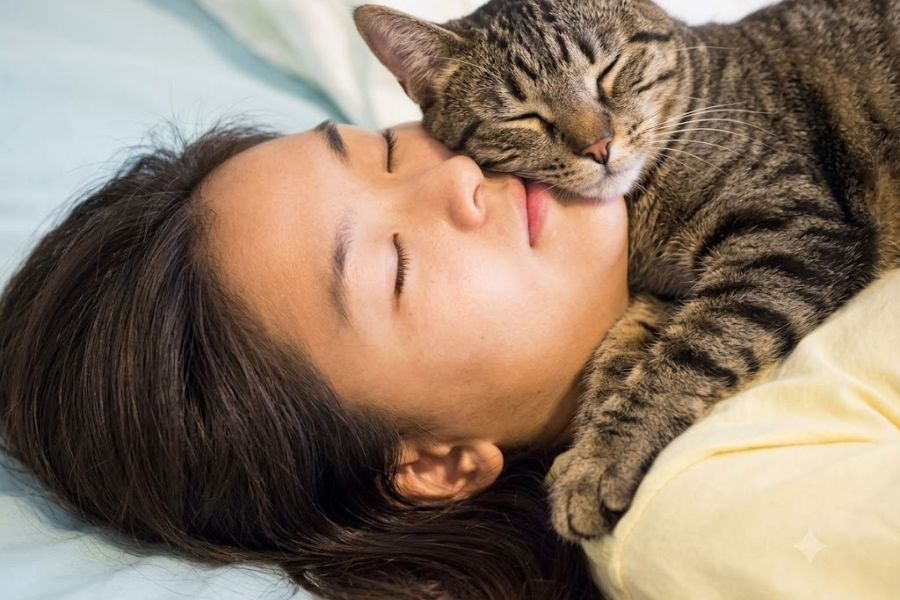
It’s Safer Up There Than You’d Think
House cats are small predators who, in the wild, are also prey for larger predators. Even a well-fed indoor cat who has never seen a fox still runs the software. When they pick a sleeping spot, they’re balancing warmth and comfort against a quiet risk assessment: how exposed am I, what can I hear, what can I see, how fast can I get out of here if I need to?
Your head solves several of those problems at once. They’re up high, which cats prefer for sleep because it gives them a sight line across the room. Your body blocks one flank, so they only have to worry about the other side.
And crucially, they can feel and hear you. Your breathing, your heartbeat, any change in either. If you stir, they know a full second before your feet hit the floor. You’re functionally their early warning system, and they’re yours, though the deal is a bit lopsided in their favor.
This is also why some cats will sleep on your chest, but many prefer just above it, tucked into the crook of your neck or on the pillow beside your face. Your chest moves too much. It rises and falls, and occasionally you cough or roll, and none of that is conducive to a proper cat nap.
The pillow is stabler ground with all the same benefits: your smell, your heat, your heartbeat close enough to hear, and a clear view of the bedroom door.
The Bond Is Real, and It Looks Different in Different Cats
There’s been some work in the last few years on cat attachment, particularly a study out of Oregon State University by Kristyn Vitale and colleagues, published in Current Biology in 2019, which found that cats form attachment styles toward their humans that resemble those dogs and human infants show.
Around 65% of the cats they tested showed what researchers classify as a secure attachment to their owner. Which is to say: your cat sleeping on your head isn’t just about the pillow being warm. She’s picked her person, and she wants to be near that person when she’s at her most vulnerable, which is when she’s asleep.
A cat who sleeps on your face is telling you something quite specific. She’s saying you’re the safe base.
If you adopted an older cat who took six months to come out from under the sofa and now sleeps with her nose in your ear, congratulations, that’s the finish line most rescue owners never quite believe they’ll reach.
Different cats show the same bond in different ways. Some cats show affection at a polite distance and only come in close when they’re properly asleep, and no one’s watching, which is why you sometimes wake up to a cat on your head who spent all evening ignoring you from the top of the bookshelf.
A Few Things To Remember
Cat dander does aggravate asthma and allergies in people who have them, and sleeping face-to-face with a cat is the most intense version of that exposure. If you wake up wheezing or with itchy, swollen eyes, a HEPA air purifier in the bedroom and washing your pillowcase twice a week can take the edge off; if it doesn’t, talk to your doctor before you resort to shutting her out, because a lot of allergy-prone people manage cats fine with the right meds.
Small children under about five shouldn’t share a pillow with a cat, mostly because a startled cat can scratch and a very small face is a bad place for that to happen. And if anyone in the house is immunocompromised, a chat with the doctor about cat contact is worth having.
If the sleeping-on-face behavior is new, and she wasn’t like this before, keep an eye on it. Cats who suddenly become clingier, won’t leave your side, or want more contact than they used to are sometimes telling you they’re not feeling well.
Look for other changes too: eating less, drinking more, using the litter box differently, hiding at other times of day, a coat that looks less well-kept than usual. Any of that alongside a big personality shift is a reason to book a vet appointment rather than assume she’s just gotten more affectionate.